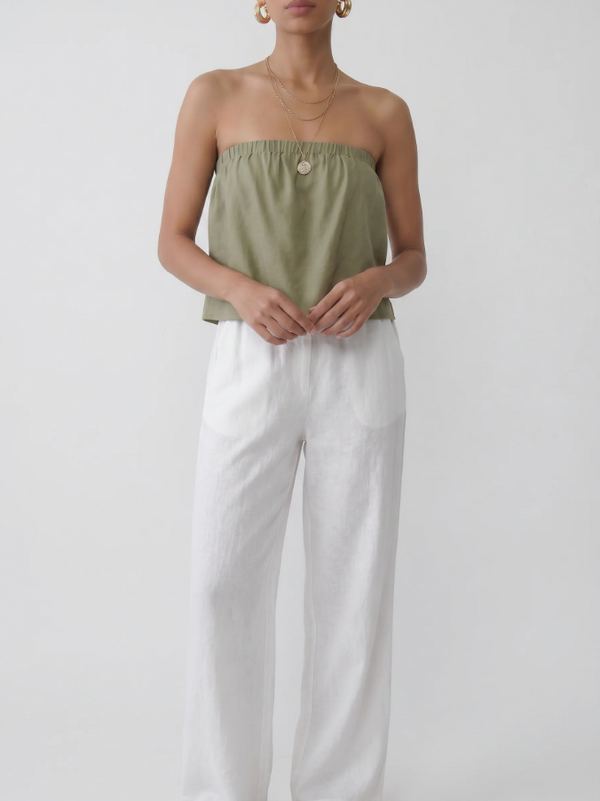
Lyocell
Filter & sort
SORT BY
What is lyocell?
Lyocell is made from wood pulp, most often eucalyptus or beech, dissolved in a closed-loop solvent process that recovers and reuses 99% of the chemicals involved. What comes out is a soft, fluid-draping fibre with a natural sheen. No petroleum, no synthetic backing.
How lyocell behaves on skin
Under a microscope, lyocell fibres have a smooth, round cross-section. That surface creates less friction against skin than cotton's irregular structure or the chemical coatings on polyester. For people with eczema or chronic skin sensitivity, this mechanical difference matters: prolonged friction is one of the main triggers for flares, not just chemical irritants.
Lyocell also pulls moisture into the fibre itself rather than letting it pool at the surface. During a full day of wear, that keeps the skin-fabric interface drier than most alternatives. No added finish is needed to achieve this. It comes from the fibre's physical structure.
Lyocell, cotton, polyester: what's actually different
Lyocell is softer than cotton and drapes more naturally. It manages moisture better than conventional cotton and far better than polyester, which holds sweat at the surface. Polyester and nylon are petroleum-derived and require chemical finishing to perform; lyocell is plant-based, biodegradable, and achieves its properties without added treatments. For people who react to sericin, the protein in conventional silk, lyocell is also a cleaner alternative. Entirely plant-derived, with nothing animal-based in the production chain.
Frequently asked questions
Is lyocell the same as TENCEL?
TENCEL™ is a brand name from Lenzing AG for their lyocell. All TENCEL™ is lyocell, but not all lyocell is TENCEL™. The fibre itself is the same; the brand name certifies the specific closed-loop production process Lenzing uses.
Is lyocell good for sensitive skin?
Yes. Dermatological research consistently places lyocell among the best-tolerated fabrics for sensitive and eczema-prone skin, citing both its low friction and moisture management (Ricci et al., 2008, Current Problems in Dermatology).
Does lyocell shrink?
It can, particularly at high wash temperatures. 30°C, reshaped while damp, air-dried flat keeps it stable.
Is lyocell sustainable?
More so than most. The solvent loop recovers 99% of chemicals. The fibre biodegrades. Eucalyptus grows without irrigation or pesticide. TENCEL™ and ECOVERO™ variants carry both the EU Ecolabel and FSC certification.


Elemente anzeigen 1-3 von 3.